sat suite question viewer
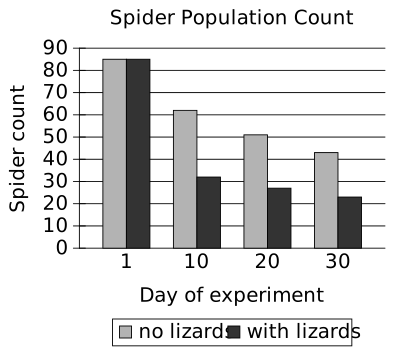
- For each data category, the following bars are shown:
- no lizards
- with lizards
- All values are approximate.
- The data for the 4 categories are as follows:
- Day 1:
- no lizards: 85
- with lizards: 85
- Day 10:
- no lizards: 62
- with lizards: 32
- Day 20:
- no lizards: 51
- with lizards: 27
- Day 30:
- no lizards: 43
- with lizards: 23
- Day 1:
To investigate the effect of lizard predation on spider populations, a student in a biology class placed spiders in two enclosures, one with lizards and one without, and tracked the number of spiders in the enclosures for 30 days. The student concluded that the reduction in the spider population count in the enclosure with lizards by day 30 was entirely attributable to the presence of the lizards.
Which choice best describes data from the graph that weaken the student’s conclusion?
Explanation
Choice B is the best answer because it describes data from the graph that weaken the student’s conclusion about the reduction in the spider population in the enclosure with lizards. The graph shows that the enclosure with lizards and the enclosure without lizards each began with about 85 spiders, and that the number of spiders in each enclosure fell over the 30 days of the study. The student’s claim is that the reduction in spiders in the enclosure with lizards is “entirely attributable to the presence of the lizards,” meaning that the spider population wouldn’t have declined except for the presence of the lizards. This claim is weakened, however, by the fact that the enclosure without lizards also saw a substantial reduction in the number of spiders. Since the number of spiders fell in the enclosure without lizards as well as in the enclosure with lizards, there must be some other factor than just the presence of the lizards that contributed to the reduction in the spider population.
Choice A is incorrect because the fact that the two enclosures started with the same number of spiders is irrelevant to the claim that the reduction in spider population by day 30 in the enclosure with lizards can be entirely attributed to the lizards. Choice C is incorrect because the fact that the spider population in the enclosure with lizards fell more between days 1 and 10 than in other periods has nothing to do with the student’s claim that the reduction in spiders in that enclosure by day 30 can be entirely attributed to the lizards. Choice D is incorrect. Although it’s true that on day 30 the spider population was lower in the enclosure with lizards than in the enclosure without lizards, this fact doesn’t weaken the student’s claim that the reduction in the spider population in the enclosure with lizards can be entirely attributed to the lizards. Indeed, the lower spider population in the enclosure with lizards suggests that the lizards are contributing to the reduction in the spider population, though the fact that the spider population also fell substantially in the other enclosure means that the lizards aren’t the only cause of the reduction.